
Treat Aquarium Nitrite & Ammonia Levels
Use DrTim’s One & Only Live Nitrifying Bacteria to Eliminate New Tank Syndrome
One & Only Live Nitrifying Bacteria Are Extremely Versatile:
- Eliminates new tank syndrome
- Instantly creates a bio filter
- Removes toxic ammonia and nitrite, naturally
- No sulfur or other offensive odors
- No wait needed
- 100% natural
Use One & Only when setting up a new tank, after a water change, cleaning your filter, when adding new fish and after a disease treatment to control ammonia and nitrite.
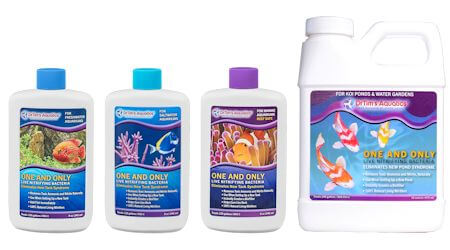
The key to setting up a successful aquarium is to quickly convert the fish waste to a non-toxic form. This is done by nitrifying bacteria. Under normal conditions it can take 30 to 45 days for these bacteria to become naturally established in a newly set-up aquarium. Unfortunately, during this time period, ammonia and nitrite can increase to levels toxic to fish – a process called New Tank Syndrome. For years, it was assumed that two particular species of nitrifying bacteria were responsible for this process but original scientific research by Dr. Timothy Hovanec showed this not to be the case. This is one reason why nitrification products have failed to work in the past.
Our nitrifying bacteria are the result of the latest scientific research and are used by public aquariums and professionals around the world.
Usage Chart
| Product Bottle Size (oz) | 2 | 4 | 8 | 16 | 32 | 64 | 128 |
|---|---|---|---|---|---|---|---|
| Amount of Water Treated (gal) | 30 | 60 | 120 | 240 | 480 | 960 | 1,920 |
| Amount of Water Treated (L) | 114 | 227 | 454 | 908 | 1,817 | 3,634 | 7,267 |
Shop by Aquarium Type
Helpful Videos
Subscribe to DrTim’s YouTube Channel for More Informative Videos
One & Only Nitrifying Bacteria FAQ’s
Dr. Timothy A. Hovanec, the founder of DrTim’s Aquatics, is considered to be one of the World’s premier authorities on nitrifying bacteria in aquaria and closed aquatic life-support systems. Dr. Hovanec’s research was the first to show the importance that previously unknown species of ammonia- and nitrite-oxidizing play in the nitrification of tropical fish aquaria and other recirculating systems. Dr. Hovanec holds over ten U.S. and foreign patents related to nitrifying bacteria and their application to freshwater and saltwater aquaria. This combination of original research and the practical application of that research means that Dr. Hovanec is uniquely qualified in the tropical fish hobby to answer general questions about nitrification in aquaria and specific questions about his new product for jump-starting nitrification in aquaria — DrTim’s One & Only Nitrifying Bacteria.
FAQs about Dr Tim’s One & Only Nitrifying Bacteria
If you don’t see your question below please submit it here
What is One & Only Nitrifying Bacteria?
One & Only Nitrifying Bacteria is the latest mixture of nitrifying bacteria by Dr Timothy Hovanec. There are formulations available for freshwater aquaria, saltwater aquaria, reef, nano, and seahorse aquaria, and koi ponds and water gardens. One & Only will quickly establish a functioning biological filter in your aquarium, allowing you to immediately add fish to your tank.
What will One & Only do for me?
One & Only is designed for one job – to quickly establish a biofilter in your newly set-up aquarium so that your fish do not experience New Tank Syndrome (NTS), which is when the water contains such high levels of ammonia and/or nitrite that your fish die. One & Only does this by containing species of ammonia- and nitrite-oxidizing bacteria that prefer to live in the fish tank environment. One & Only is not a sludge buster nor will One & Only remove nitrate. One & Only will maintain ammonia and nitrite below toxic concentrations and establish a fully functioning biological filter in less than half the time of a similar but non-dosed aquarium.
How should One & Only be added to the aquaria?
Before adding One & Only to your tank, make sure the water has been dechlorinated. Research has shown that One & Only can be safely used with DrTim’s Aquatics’ AquaCleanse tapwater detoxifier. Other dechlorinators can be used but some are actually harmful to One & Only: do not use any product that contains aldehydes in its formula. UV-sterilizers and protein skimmers should be turned off before adding One & Only and remain off for 36-48 hours after dosing.
It is important to shake the bottle well before adding One & Only. If you see only a clear liquid you have not shaken One & Only well enough. Pour the One & Only over the biological filter media in your biofilter. If you do not have dedicated filter media it is fine to pour the liquid into the fish tank water.
When should One & Only be added?
One & Only should be added after the tank has been set up. At this point the water should have reached the proper temperature and have been dechlorinated. Start the filter and make sure it is functioning and then add One & Only. Fish should be added within 24 hours of adding One & Only nitrifying bacteria. An alternative to adding fish is to add some ammonia to the water.
How many fish can I add to the aquarium after dosing with One & Only?
This is the hardest question to answer because every situation is different. One & Only will dramatically reduce the time it takes to establish a biofilter in your newly set-up aquarium. However, even One & Only has limits.
For instance, if you set up a saltwater tank and use uncured live rock, One & Only may not be able to initially control the ammonia concentration in the water because there will be too much decay of organic matter from the uncured live rock.
Or if you let every friend of your kids feed the new fish tank such that you are grossly overfeeding the tank, One & Only will not be able to maintain low levels of ammonia and nitrite.
Also, some fish species are very sensitive to any amount of ammonia in the water so these fish should not be added to the tank in the first 20 or so days after set-up.
In general, you can add one giant danio-sized fish per gallon when initially dosing with One & Only. Feed normally and monitor ammonia and nitrite levels in the water. You might see a little ammonia or nitrite for a day or so but this will quickly disappear. You can then add more fish to the aquarium.
How is One & Only different from other bacterial additives?
One & Only Nitrifying Bacteria is different than other bacterial mixes on the market today for a variety of reasons:
-
- It is the only mixture currently available to the hobbyist that is grown and certified by Dr. Timothy A. Hovanec,
- The ammonia- and nitrite-oxidizing bacteria in One & Only are grown together as a microbial community of bacteria which means they work together more effectively.
- The bacteria in One & Only are grown on a microstructure, not as “free” cells in water, which helps the bacteria stay active for a longer time period.
Does One & Only ALWAYS have to be refrigerated?
No. One & Only should never be frozen, nor should it be kept at temperatures above 95°F. Normal room temperature will not harm the bacteria in One & Only. Perhaps it is easier to think about it this way: One & Only is not like an ice cream cone. Once ice cream is exposed to room temperatures it starts to melt, and if it completely melts you have a mess and no longer ice cream. One & Only is not like this. One & Only will last for 6 months at room temperatures (65 to 85°F). At colder temperatures (around 50°F) One & Only will last one year.
How should One & Only be treated in relation to temperature?
The best way to handle One & Only is to treat it the same way you would treat your fish. You wouldn’t keep the bag of fish you just bought at the fish store in direct sunlight in your car for hours while you continued shopping nor would you let that bag of fish freeze — the same goes for One & Only. Keep One & Only in moderate temperatures and it will be perfectly fine when you get it home and are ready to use it.
What about the longer term storage of One & Only?
At a temperature of about 50°F, One & Only will be viable for one year. Each bottle is stamped on the back with the words “best used by” and then a month and year.
When should I use One & Only?
Use One & Only when setting up a new tank and after major environmental changes to your aquarium. Examples of major changes include a disease treatment with antibiotics or chemicals that are harmful to the nitrifying bacteria, after a major gravel cleaning which can disturb the bacteria on the gravel and after a failure of the filter.
Can One & Only be used for fishless cycling?
Yes, but there is no real reason to do fishless cycling with One & Only. However, if you choose to go that route you need to add ammonia to the water after dosing the One & Only because the bacteria need some source of ammonia to start growing a bigger population. Dose ammonia to an initial concentration of 2 to 4 ppm which should disappear quickly, with nitrate increasing a little then disappearing. Dose one or two more times with ammonia and after your test kits show no ammonia and nitrite, it is safe to start adding fish.
What does the lot code and date label on One & Only mean?
The lot code is just a way for us to track the manufacturing and bottling process of One & Only. The lot number does not have a special code; it is just the lot assigned to the batch of One & Only bottled at that time. The “best used by” date is the date we recommend one uses One & Only by. It does not mean that One & Only will be totally ineffective after that date, only that the efficacy of One & Only will have decayed, but using One & Only will still establish a biofilter faster than doing nothing at all.
How can bacteria live in a bottle and not die for 6 months or a year?
A common misconception about bacteria in general is that they die if they are not fed. From a human being point of view this sounds perfectly reasonable: if you don’t eat, you die. However, bacteria are not human beings. Bacteria operate much differently than people and have a variety of ways to deal with those times when resources are not available for them to grow and reproduce. Some bacteria when stressed (from say lack of nutrients) form spores and go into a resting stage, waiting for conditions to improve. Nitrifiers do not form spores but have other mechanisms to deal with nutrient deficient periods. For nitrifiers, one way to deal with stressful conditions is to form a protective “shield” called EPS. EPS stands for extracellular polymeric substances and is, in simplistic terms, an organic protective shield that research shows inhibits various organisms from attacking and breaking open the cell wall of nitrifiers. Nitrifiers belong to a very old line of bacteria (millions of years) and they have developed ways to cope with very long periods of “drought.” Because the nitrifiers in DrTim’s One & Only are grown on a substrate, they can form EPS when needed and last 6 to 12 months in a bottle.
I have a Brackish water tank – which bacteria is for me?
The choice of whether to use the Freshwater One & Only or the Saltwater One & Only bacteria in a brackish water tank depends upon the salinity (or specific gravity [S.G.]) of your water.
-
- If your salinity is less than 10 ppt (1.007 S.G.) then use the freshwater formula.
- If your salinity is greater than 10 ppt (1.007 S.G.) then use the saltwater formula.
Troubleshooting One & Only Nitrifying Bacteria
This section is designed to answer problems you might experience with your tank in which you dosed One & Only Nitrifying Bacteria. If none of the existing answers give you the solution to your problem, please contact us.
I added One & Only and the next day the aquarium water was cloudy or milky
Cloudy water is not caused by nitrifying bacteria because they cannot multiply fast enough to reach a population level that would turn the water cloudy. Cloudy water is generally caused by a bloom of heterotrophic bacteria in response to elevated levels of organics in the water. This can be reduced by thoroughly washing the gravel, rock and other items before placing them in the aquarium. The best way to control cloudy water is to do a partial water change and limit feeding. The water will usually clear up after a day or two.
I added One & Only to my tank which already had high ammonia (nitrite) and the concentrations did not drop
If the ammonia or nitrite concentration in the aquarium is above 10 ppm (as nitrogen) or 10 mg/L-N, you should do a partial water change before adding One & Only. The reason is that these bacteria prefer low concentrations of ammonia/nitrite and can actually be inhibited by high levels of these chemicals. Thus, a tank which already has high ammonia (or nitrite) will not see results as fast as if you had added One & Only at the beginning. There are two solutions: 1) change water or 2) add more One & Only while reducing feeding until the situation resolves itself.

 Yes, there really is a Dr. Tim. It all started with 2 goldfish won at a school fair at age 6 that didn’t survive their first night in his care. DrTim’s gotten better at fish keeping since then! Read Our Story.